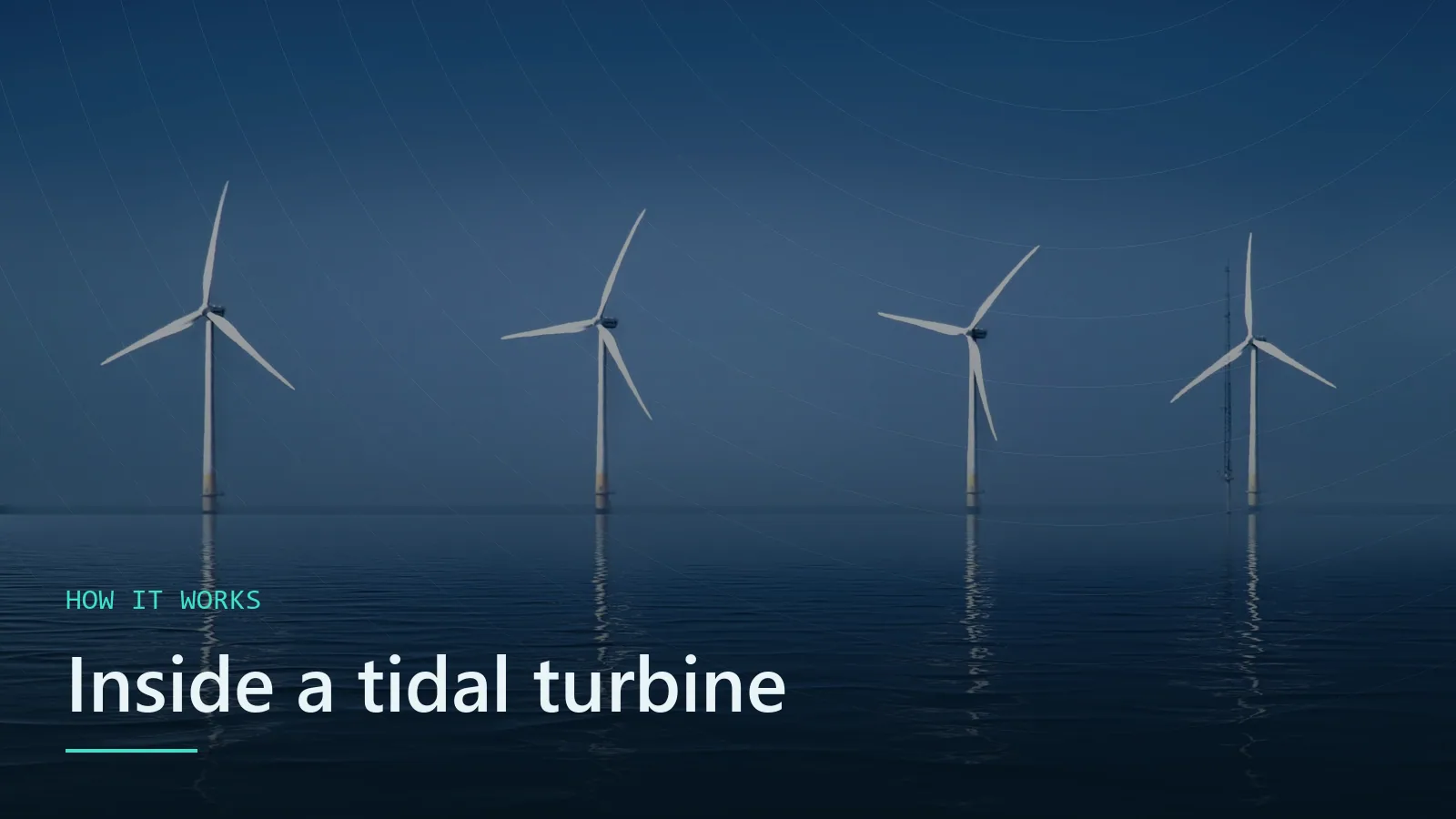
What is a tidal turbine?
A tidal turbine is a rotor driven by tidal currents rather than wind. Because water is dense, the blades are short and the rotor turns slowly.
A tidal turbine is a machine that converts the kinetic energy of a tidal current into
electricity, using a rotor on a shaft driving a generator. In outline it is a wind turbine placed
underwater, and the differences all follow from the medium it sits in.
Short blades, slow rotation
Seawater is about eight hundred times denser than air, so a current of a few knots carries
force comparable to a strong gale. A tidal rotor is therefore compact for its output and turns
slowly, often under twenty revolutions per minute.
That slow rotation matters twice: it reduces fatigue on the structure, and it is central to
the argument about marine life, since a slow blade is far easier for an animal to avoid.
It has to work in both directions
The flood and the ebb run opposite ways. Designs answer this by yawing the whole nacelle
around, by pitching the blades to reverse their angle of attack, or by using symmetrical blades
that do not care which way the flow arrives. Pitching avoids moving the heavy parts and is common.
Holding it in place
Most of the engineering effort goes into the structure rather than the rotor. Gravity bases
sit on the seabed under their own weight and need a flat firm bed. Piled foundations are driven
in and need something to drive into. Floating platforms moor above the turbine and avoid both
problems at the cost of station keeping in a reversing current.
What it is not
A tidal turbine is not a tidal barrage. A barrage is a dam across an estuary that uses the
difference in water height, while a turbine uses the horizontal current. They are different
technologies with different footprints, compared in types of tidal energy.
For how the whole machine works end to end, see
how a tidal turbine works.